

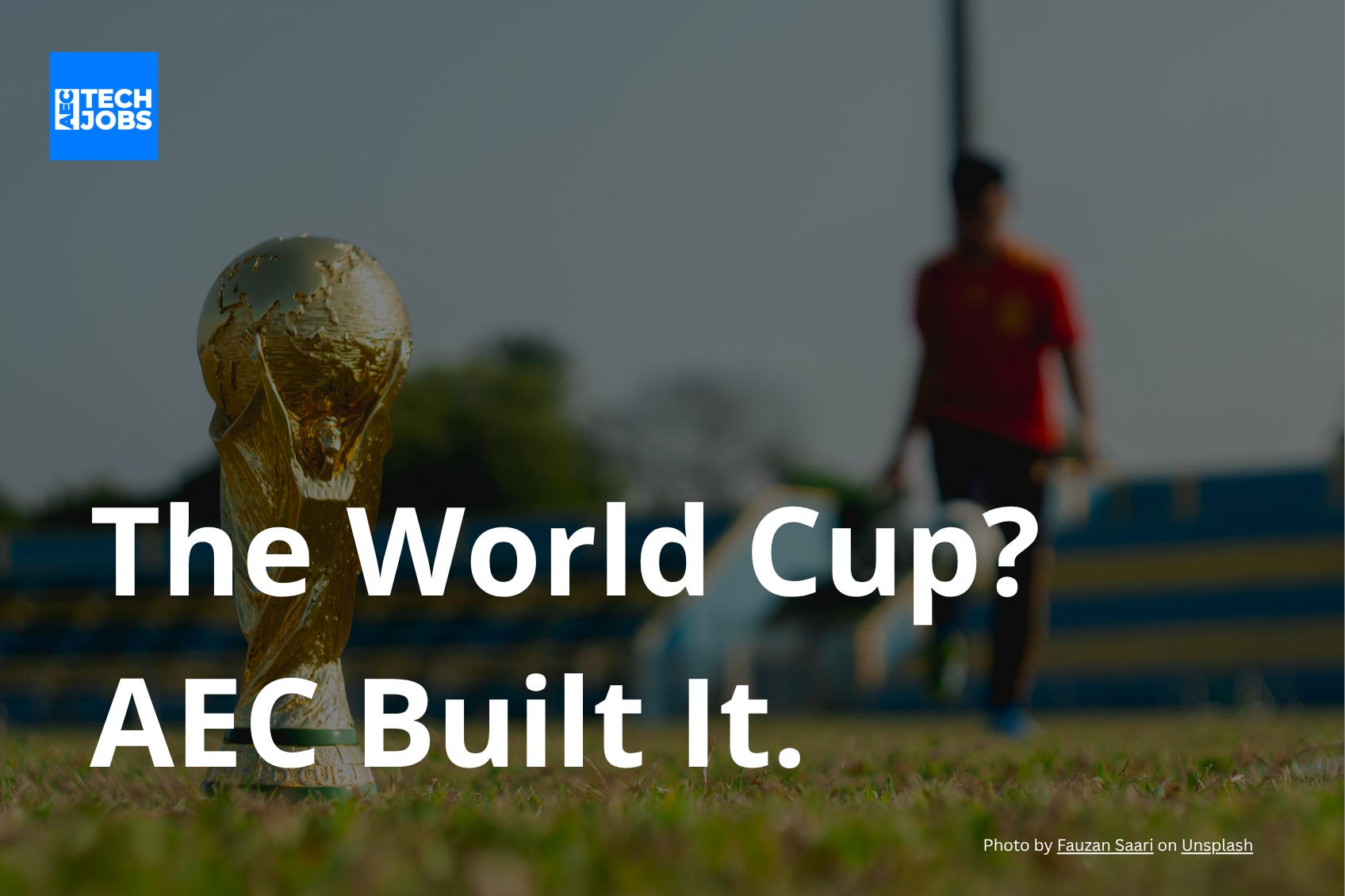
The World Cup? AEC Built It.
Your go-to source for staying connected with industry trends, company highlights, and career opportunities in Architecture, Engineering, and Construction Technology.
Last issue, we asked: Which part of the pivot feels hardest right now?
Here’s how it broke down:
Getting responses / interviews — 67%
Positioning my background for tech — 33%
Same wall, different issue. Getting in the door is still the hardest part — and it’s exactly what Part 2 of the AEC Tech Pivot Challenge is built for. Free, self-paced, worth 10 minutes of your time.
But today, we’re doing something a little different.
The 2026 FIFA World Cup kicked off last week. And while everyone else is talking about squads, group stages, and who’s going to win it all — we want to talk about something nobody else is covering.
Before the first kick, someone had to build all of this.
What we are reading/watching in the AEC world:
The World Cup is the biggest construction project you forgot about. Over $2 billion in stadium renovations. 16 venues across 11 cities in the US, Canada, and Mexico. Skanska at MetLife. Populous at Levi’s. HKS across AT&T and SoFi. These are the firms that made it happen — under insane deadline pressure, across three countries, simultaneously. And according to CCE Online News, the projected GDP impact is $17.2 billion with an estimated 185,000 jobs tied to the tournament’s construction footprint. Read the full breakdown here.
Cities used the World Cup as a hard deadline to finish infrastructure they’d been delaying for decades. Seattle’s Crosslake Connection light rail — originally planned in the 1960s, construction started in 2016 — finally opened in March because “the World Cup was a we-must-have-this-open moment.” Kansas City extended its streetcar. Atlanta redesigned its entire bus network. The federal government put $100 million toward transit upgrades across all host cities. This is what a forcing function looks like in AEC. Read more here.
Every one of those 16 stadiums now has a digital twin. 3D laser scanning, BIM workflows, point cloud documentation — venues needed to be mapped in full detail for security teams, broadcast production, and operational planning. The tech that AEC has been slowly adopting for years got a full stress test across 16 simultaneous mega-projects. If you want to see where scan-to-BIM is right now, the World Cup is one of the best case studies out there. Read more here.
Top Opportunities
Whether you’re job searching or just looking around! Check out the full job board here!
Design Technology Manager | HGA | Minneapolis, Boston, Washington DC, Milwaukee, or San Francisco
Operations Analyst | PermitFlow | Philippines (Remote)
Product Manager | Now Vision | Pescara, Italy
World Model Evaluation Lead | Archetype AI | San Mateo, CA (Remote)
Head of People & Performance | Monumental | Amsterdam, Netherlands
Accounting & Admin Assistant | Offsite | USA (Remote)
Staff Software Engineer – Backend | Kantiv | India (Remote)
APAC Sales Lead | Aphex | Australia (Remote)
Strategic Product Owner | Transcend | Hungary (Remote)
Design Engineer | Kinship | London, UK
Sales Executive | dRofus | Singapore
Strategic Finance Lead | Bedrock Robotics | San Francisco, CA
The World Cup Starts This Week. AEC Built It.
Billions of people watched the opening match last week. They’ll see the pitch, the players, the flags, the lights.
They won’t see the people who made it possible.
So let’s talk about them.
Before the first kick, someone had to build the stadium.
Fourteen of the 16 World Cup venues are existing NFL, MLS, and Liga MX stadiums that were renovated specifically for this tournament. That sounds simple until you realize what it actually meant: natural grass pitches grown off-site and transported under refrigeration. Modular seating systems designed to work for both NFL and FIFA configurations. At Kansas City’s Arrowhead, 5,100 cubic yards of earth and rock removed. Nine million pounds of concrete taken out. Then put back differently.
At MetLife — the venue hosting the final — Skanska led the renovation. At Levi’s Stadium, Populous. At AT&T and SoFi, HKS. These are names you know. And they pulled this off across 16 venues, in three countries, simultaneously, under a deadline that didn’t move.
The World Cup is the biggest construction project you forgot about.
The total tab? Over $2 billion in stadium renovations alone — and that doesn’t include the city-level infrastructure running alongside it. The federal government put $100 million into transit upgrades across all 11 US host cities. Seattle finally opened a light rail line that was planned in the 1960s and started construction in 2016. Why now? Because the World Cup was the hard deadline that finally made it happen.
Atlanta redesigned its entire bus network. Kansas City extended its streetcar. Across every host city, the tournament forced the kind of infrastructure action that years of planning meetings couldn’t.
The full economic footprint? $17.2 billion in projected GDP impact. 185,000 jobs.
The tech you’ve been reading about got stress-tested at scale.
Every single one of the 16 venues now has a digital twin. 3D laser scanning, BIM documentation, point cloud models — used by security teams, broadcast crews, and operations staff who needed to know these buildings better than anyone who’d ever worked in them. AI-assisted security systems. IoT sensor networks. 5G connectivity woven into structures that were built decades before any of that existed.
This is the thing about mega-events that rarely gets said: they’re one of the few forcing functions that make the construction industry actually move fast. The technology was ready. The deadline made it real.
And now — the jobs that made all of this happen are the same jobs available in AEC tech today.
The people who managed BIM on stadium renovations. The ones who ran digital twin workflows across concurrent projects in three countries. The project managers who coordinated structural steel across a supply chain under tournament pressure. The design technologists who figured out how to make an NFL field into a FIFA pitch.
Those are real, transferable skills. And the companies hiring right now — the ones on our job board — are looking for exactly that kind of experience.
The World Cup doesn’t just happen. People build it. People like the ones in this community.
Now let’s get you into the next one.
This week’s poll:
Vote below — curious where this community lands!
Enjoy the games this month. And if you spot something in the coverage that makes you think about the AEC angle — hit reply. We love hearing it.
Rooting for you (and your team!)
— Stefanie & the AEC Tech Jobs team Co-founder, AEC Tech Jobs
PS: The next edition will land in your inbox in 2 weeks! Have a question or want to make sure I’m human? DM me!
Thanks for reading Behind AEC Tech Jobs! Subscribe for free to receive new posts and support my work.